
19th May 2026
Why Soldiers Wear Cat Eyes on Their Helmets (Military Explained)
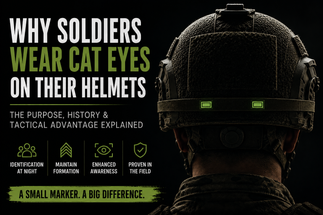
If you’ve ever seen U.S. soldiers moving at night with two glowing squares on the back of their helmets, you’ve seen one of the military’s simplest — yet most effective — pieces of field gear: helmet cat eyes.
These reflective helmet bands have been used by generations of American troops to improve nighttime visibility, maintain formation discipline, and reduce confusion during combat operations and field training.
Even with today’s advanced night vision technology, military cat eyes remain standard equipment because they solve a critical battlefield problem: helping soldiers identify friendly personnel in low-light environments without using bright lights.
What Are Military Cat Eyes?
Military cat eyes are reflective patches attached to the rear of a combat helmet band. They are commonly found on:
- ACH helmets
- ECH helmets
- PASGT helmets
- Tactical combat helmets
- Training helmets
The reflective tabs are designed to bounce light back toward its source, creating the appearance of glowing “eyes” in darkness — which is where the nickname “cat eyes” comes from.
Most military helmet bands feature:
- Dual reflective squares
- Elastic helmet retention band
- Camouflage retention slots
- Optional infrared (IR) tabs for night vision operations
Why Do Soldiers Wear Cat Eyes?
Night Identification During Tactical Movement
The primary reason soldiers wear cat eyes is to identify friendly personnel during nighttime movement.
In low-light conditions, troops often move in single-file formations through terrain where visibility is extremely limited. Cat eyes allow soldiers to quickly locate the person in front of them without using flashlights or visible lighting that could expose the unit’s position.
This helps units:
- Maintain formation spacing
- Prevent separation at night
- Reduce confusion during movement
- Improve accountability
- Navigate terrain more efficiently
In military operations, maintaining formation and unit cohesion in darkness is critical.
Cat Eyes Help Prevent Friendly Force Confusion
One of the biggest risks during night operations is misidentifying friendly troops.
Cat eyes provide a subtle visual identifier that allows soldiers to distinguish friendly movement from unknown movement, especially during:
- Field exercises
- Patrols
- Convoy operations
- Land navigation
- Tactical training
- Combat deployments
Some helmet bands also feature different reflective patterns that can help identify leadership positions or orientation within a formation.
Why Soldiers Still Use Cat Eyes Today
Modern militaries have access to advanced technology like:
- Night vision goggles (NVGs)
- Thermal optics
- Infrared systems
- Drone surveillance
So why are cat eyes still used?
Because they are:
- Lightweight
- Reliable
- Battery-free
- Durable
- Cost-effective
- Easy to identify under stress
Simple equipment often performs best in demanding environments. Cat eyes continue to work effectively in rain, mud, dust, and harsh field conditions where electronic systems may fail or become impractical.
Are Cat Eyes Dangerous in Combat?
Some soldiers argue that reflective cat eyes can create a visibility risk at night by making troops easier to spot.
That concern is valid in certain tactical environments. However, military operations require balancing concealment with coordination.
In most situations, the risk of:
- Losing formation
- Becoming separated
- Misidentifying friendly troops
- Creating confusion during movement
is considered greater than the small visibility signature created by cat eyes.
That’s why military units continue using them today.
Modern versions also include infrared (IR) cat eyes, which are visible primarily through night vision devices instead of the naked eye. This allows friendly forces to identify each other while minimizing visible light exposure.
The History of Military Helmet Cat Eyes
Helmet cat eyes became widely recognized during the Vietnam era and continued evolving through modern U.S. military combat operations.
Over time, they became standard issue field gear because of their effectiveness during nighttime movement and low-light operations.
Today, cat eye helmet bands remain closely associated with:
- U.S. Army infantry
- Marine Corps combat units
- Field training exercises
- Tactical operations
- Military culture and gear loadouts
For many veterans, cat eyes are instantly recognizable symbols of time spent in the field.
What Is an IR Cat Eye Helmet Band?
Modern tactical helmet bands often include infrared reflective tabs that work with night vision equipment.
Benefits of IR cat eyes include:
- Reduced visible signature
- Improved night vision identification
- Better coordination during NVG operations
- Enhanced low-light tactical awareness
These are commonly used in modern military and tactical environments where night vision equipment is standard.
Why Helmet Bands Matter Beyond Reflection
Helmet bands do more than hold cat eyes.
Soldiers also use them to secure:
- Camouflage material
- IR markers
- Small notes
- Vegetation during field exercises
- Identification tabs
The elastic band helps turn a combat helmet into a more functional field tool.
Military Helmet Cat Eyes & Tactical Gear
Whether you’re replacing issued gear, building a tactical setup, collecting military equipment, or preparing for field training, quality cat eye helmet bands remain an essential piece of combat gear.
A properly made military helmet band should offer:
- Durable elastic construction
- Strong reflective visibility
- Secure helmet fit
- Long-lasting stitching
- IR compatibility when applicable