
Posted by Case Smien on 2nd Dec 2025
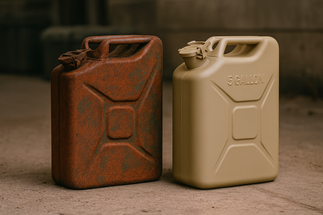
The Military Fuel Can Has Evolved: Why the New U.S. Military & NATO 5-Gallon Cans Are Plastic—Not Metal
For most of the 20th century, the 5-gallon steel jerry can was as iconic as the Humvee, ALICE pack, or M65 field jacket. If you served, deployed, wrenched on vehicles, or stored fuel in the field, you know exactly what those metal cans looked like: welded seams, stamped steel, and lids that seemed immortal—until they weren’t.
But that era is gone.
Today, the U.S. Military and NATO no longer rely on steel fuel cans. The modern standard is a high-density polyethylene (HDPE) polymer container engineered through updated military specifications.
This wasn’t a cosmetic update. It was a solution to very real failures that steel couldn’t overcome.
→ Own the same fuel can trusted by soldiers
The Metal Fuel Can: A Legend With a Fatal Flaw
The original steel jerry can was brilliant for its time—rugged, stackable, and strong. It earned its reputation the hard way: on convoys, in motor pools, and strapped to the backs of vehicles all over the world.
But it carried a built-in problem the military could never fully fix: steel corrodes, and fuel does not forgive corrosion.
The longer a steel can lived, the more it became a liability:
- Moisture and humidity created rust inside the can
- Contaminants flaked off into stored fuel
- Engines choked, clogged, or failed
- Scratches exposed raw metal, accelerating damage
- Cans stored on vehicles or ships degraded quickly
- Lids, once plentiful, became a rare surplus commodity
Ask any surplus collector today what the hardest part of an old steel can is to replace. They won’t say the body. They’ll say the lid. Most are gone, rusted out, or snapped from stress.
By the time the military reached the 1990s and early 2000s, rust wasn’t just an inconvenience—it was a supply chain hazard.
Fuel systems became more complex. Engines became more sensitive. Contamination wasn’t an annoyance; it was operational failure.
The steel can reached its technological ceiling. The mission had evolved. The container had not.
The Fuel Can Built for Modern Warfare
The military needed a container that:
- Didn’t rust
- Didn’t shed contaminants into the fuel
- Didn’t require repainting or corrosion control
- Didn’t fail when dropped, frozen, soaked, or mounted externally for months
Steel couldn’t do that. Plastic could—but only if it was engineered correctly.
Why the Military Chose Plastic
Not all plastics are created equal. A consumer-grade gas can from a hardware store is not a military fuel can and never will be. The military standard demanded:
1. Zero Corrosion
No rust. No flakes. No chemical reaction with fuel. Storage remains clean, engines stay protected, and the can’s lifespan extends indefinitely.
2. Superior Impact Resistance
A steel can dents. A dent stresses seams. A stressed seam eventually cracks.
Military-grade polymer containers flex, absorb energy, and return to shape without losing integrity. That matters when cans are dropped, thrown, or slammed around in real-world use.
3. Lighter Weight
A full steel can is a deadlift. A full plastic can is manageable.
In the field, weight equals speed, and speed equals survival. Lighter containers mean less fatigue and more efficiency for troops and crews handling fuel all day.
4. No Paint, No Maintenance
There’s nothing to scrape, chip, or refinish. The can is the material—not a coating waiting to fail. That eliminates an entire category of maintenance.
5. NATO Compatibility
Current military-spec polymer cans are built to NATO dimensions and interface with modern vehicle mounts, pallet systems, and storage racks across allied forces.
6. Chemical Resistance
Diesel, gasoline, kerosene, JP fuels—modern fuel cans use fuel-rated HDPE designed to handle these without softening, cracking, or contaminating the contents.
The result is not a “plastic alternative.” It is the current military standard because it solved every weakness of the steel can without inheriting new ones.
Why You Don’t See Old Metal Cans Everywhere Anymore
If metal jerry cans were perfect, they’d still be here.
Instead, you find piles of surplus cans missing caps, missing lids, or rotted through. Replacing a usable lid today is like trying to source original M1951 snap fasteners—possible, but increasingly impractical.
The supply didn’t dry up by accident. The military stopped replenishing them.
They moved on.
The Modern Fuel Can
When you buy a modern military fuel can, you aren’t buying a cheaper civilian substitute. You’re buying the evolution of a battlefield tool the military could not afford to let fail.
Specifications you can count on:
- HDPE military-grade construction
- Corrosion-proof tank body
- Leak-resistant cap and gasket system
- Designed for extreme climates and vehicle use
- Built to NATO dimensions and compatibility
- The same style of container issued to U.S. and allied forces
This is the can the steel jerry can wishes it could have grown into.
Metal vs. Modern Polymer: Pros, Cons, and Real-World Toughness
To be fair and practical, it’s worth looking at both sides. Metal and modern polymer each have strengths—and understanding them helps you choose the right can for the job.
Advantages of Metal Cans
- Heat and flame resistance: Steel will not melt in high ambient heat and can tolerate brief exposure to flames better than plastic. (Fire is still a serious hazard either way.)
- Rigid structure: Metal walls stay stiff under heavy stacking and strapping when the can is in good condition.
- Long static storage with maintenance: With perfect paint, careful handling, and controlled storage, a metal can can last for decades.
Disadvantages of Metal Cans
- Corrosion risk: Once rust starts, it’s hard to stop. Inside rust becomes fuel contamination; outside rust becomes leaks.
- Weight: Heavier when empty and significantly heavier when full. Harder to move, lift, and pour—especially repeatedly.
- Dent and seam damage: Impacts create dents that stress welds and seams, which can eventually fail.
- Maintenance burden: Requires repainting, rust control, and more careful storage to stay reliable.
Advantages of Modern Polymer Cans
- Corrosion-proof: No rust, no interior flaking, no metal contamination in fuel.
- Lighter weight: Easier to carry, lift, and pour—especially when full or when handling multiple cans.
- Impact-resistant: Designed to flex rather than dent, maintaining structural integrity after drops and rough handling.
- Low maintenance: No paint, no rust mitigation, and no refinishing required.
- Balanced performance in hot and cold: HDPE military-spec cans are engineered to tolerate both high heat and sub-freezing temperatures without cracking under normal use.
Common Concerns: Sun, Heat, and Cold
A fair question people ask is: “Will plastic rot in the sun?”
Modern military-style polymer cans are typically made from UV-stabilized HDPE. That means:
- They are designed for long-term outdoor exposure on vehicles, trailers, and in the field.
- They can withstand years of sun, rain, and temperature swings without crumbling like cheap consumer plastics.
- They remain flexible in the cold rather than turning brittle under normal operating conditions.
That said, no material is indestructible. Extreme, constant UV exposure over many years will eventually age any plastic. The same way unchecked rust will eventually eat through any steel.
Best practice for both materials:
- Store out of direct sun when possible
- Avoid leaving fuel in any container for longer than recommended
- Inspect regularly for damage, deformation, or gasket wear
In realistic use—on vehicles, in the back of trucks, in racks, and in the elements—modern polymer military-spec cans are built to last and to outperform steel in most operational categories that matter: clean fuel, reliability, and ease of handling.
Final Assessment: The Debate Is Over
Metal fuel cans had their place, and they earned their reputation. But they were a product of the industrial age.
Polymer military-spec fuel cans are a product of the modern battlefield.
One rusted-out, dented can in a motor pool could stall a convoy, contaminate a generator, or cripple an engine. Once the military discovered they could eliminate that risk entirely, the decision was made—and it was permanent.
The steel jerry can is history.
The polymer fuel can is doctrine.
Own the same style of container trusted by today’s warfighters:
Military-Spec 5-Gallon Fuel Can – Available at Military Depot